

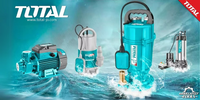
How to remove an airlock in a water pump
, by Total tools, 9 min reading time
, by Total tools, 9 min reading time
This guide aims to help you effectively understand how to remove an airlock in a pump by identifying its root causes and explaining practical methods to eliminate it. By following these guidelines, you will be able to restore your pumping system to its highest possible performance and avoid common mistakes.
An airlock occurs when air bubbles get trapped inside the pump or pipes, obstructing the flow of liquid. This is similar to a kink in a hose, where trapped air prevents water from flowing naturally. As a result, the pumping rate may significantly decrease or stop entirely, as pumps cannot move air as efficiently as liquids due to air's lower density.
Several reasons lead to airlocks within pumping systems, and it is important to know them to avoid operational problems. Below are the most prominent causes and their effects:
When the pump cannot generate enough force to overcome the resistance of the piping network, air bubbles may form, hindering the flow of liquid. This often occurs in systems with long or complex pipes, where water needs to pass through long distances or numerous bends and valves.
💡 Tip: When choosing a water tank or pump, make sure it is suitable for your specific needs and provides sufficient pressure. For example, Total Tools offers a wide range of water pumps, including surface, submersible, sewage, fountain, and deep well pumps, all of which feature high-pressure capabilities to help prevent airlocks.
Even the smallest openings in the suction pipe can allow air to enter the system, leading to the formation of air bubbles that hinder the pump's operation. This leak weakens the negative pressure required for the pumping process, as air mixes with water to form a less dense liquid that the pump struggles to move. This results in reduced efficiency and potential damage to components due to cavitation.
When the water level in the tank drops to a point where the pump's suction opening is exposed to air, the pump's self-priming system is affected. This problem is common in systems experiencing varying demand or insufficient water supply. Additionally, low water levels can create air vortices that allow air to enter the pump with the water, exacerbating the problem.
Small gaps caused by a loose threaded connection allow air to leak into the system, leading to the formation of bubbles that reduce water flow efficiency. Over time, this can lead to a complete airlock. Therefore, it is advisable to regularly check these connections and tighten them securely to avoid the problem.
Now that you are familiar with the common causes of airlocks, here are the most effective ways to remove an airlock in a water pump and restore its normal performance:
If you notice persistent air bubbles, reduced water flow, or damage to the hose, it's time to replace it. Replacement steps:
Turn off the pump and ensure pressure is relieved.
Carefully remove old hoses to avoid damaging connections.
Install new hoses of the appropriate diameter and length.
Fill the pump with water before starting to expel any trapped air.
Restart the pump and ensure normal flow resumes.
Improper installation can lead to air leakage into the system. Therefore, ensure the suction hose is fully submerged in water and check all connections for tightness and no leaks. After confirming this, run the pump to expel any remaining air.
Misalignment or loosening of the threaded connection can cause air leakage. Inspect the connection carefully, readjust its position if necessary, then tighten it securely to prevent any leaks.
When the pump is installed at a significant height compared to the water source, it may struggle to generate sufficient suction pressure, leading to the formation of air pockets. Reducing the vertical distance between the pump and the water level helps improve the suction process and reduces the chances of airlocks.
Filling the system with water slowly helps air escape gradually. Partially open the fill valve and let the water flow slowly, listening for the sound of bubbles as they exit. Continue this until the pump and all pipes are completely filled with water.
Over time, sediment can accumulate inside the valve, hindering its operation and causing air to become trapped. To clear the blockage, turn off the pump, carefully dismantle the valve, clean it thoroughly with a brush and water, then reassemble it and run the pump to check its performance.
An airlock within a water pump can be an annoying problem, but it is usually easily resolved if the correct steps are followed. Understanding the potential causes and knowing how to remove trapped air will help you maintain system efficiency and prevent future malfunctions. If the problem persists, it is advisable to contact a specialized technician or an authorized service center for the necessary assistance.